Creating an environment from scratch may seem like a daunting task. But the lessons in Pablo Dominguez‘s new course Environment Concept Art help to simplify the process. With a unique workflow that integrates abstraction and happy accidents, Pablo is able to create sweeping cityscapes in relatively little time. Student Daniel Garelik put those lessons to the test, and created a gorgeous fantasy world of his own. We spoke to Daniel about his artwork, his approach to creativity, and the origins of his design in a D&D campaign!
Learn Squared: Tell us about the world of Belas. What kind of civilization is it, and what visual themes did you want to emphasize?
Daniel Garelik: Belas is a Drow town hidden up in the mountains for my D&D campaign. [In the Dungeons & Dragons lore] Drow are elves that don’t like to be in direct sunlight, and commonly live underground. So I imagine Belas to be a bridge city between the surface and underground worlds. Like an iceberg, it would be a small town upstairs and possibly a huge city underground. I’m imagining it to be a very religious city. They don’t like sunlight, but it’s their duty to guard the gate between the surface and the underground, keeping the horrors from below at bay, and preventing outsiders from entering. They don’t like the Sun, but they might worship the moon. I haven’t decided yet, since the Drow famously worship spiders. Maybe there is a conflict between the two religions inside the city, which would further increase the duality.

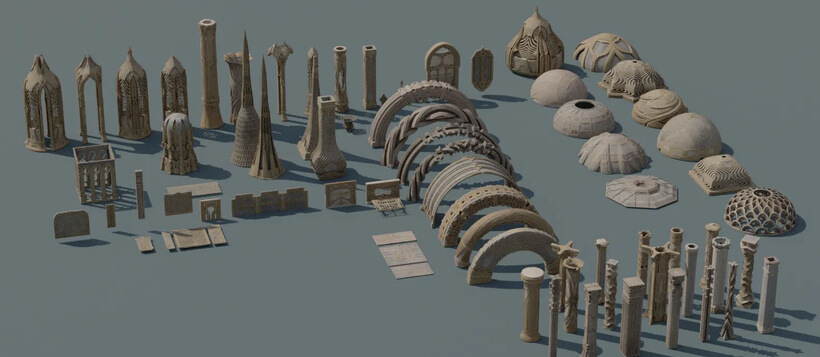
Pictured: Some of the custom kitbash elements Daniel created for his environment.
LS: How did your D&D campaign play into the creation process for the image itself? Did you have some of these visual concepts figured out before starting on the artwork?
Daniel: D&D is my recent passion, I dove right into homebrew world creation as soon as I tried [the base game], also having been inspired by Critical Role (a popular D&D webseries). For me it became a way to put my random ideas into the context of a single world, and make my friends suffer. For Belas I got inspired by the Cappadocia region of Turkey and thought that it would be interesting to combine it with elves. So, it became Byzantine + Art Nouveau architecture. The context is just something I came up during sketching. I thought of Cappadocian mountains, and how they provide shade and partially swallow some of the buildings like an ant hill. Then I decided that the houses themselves should drop more shadow too. I didn’t want to make it spooky, but to find a [good balance between these styles].
LS: In his course, Pablo shows a lot of unique brainstorming tricks for the concepting stage. What were your goals when creating your abstract ‘shape templates’? Did your design idea change as it went along due to any happy accidents?
Daniel: I think this part is the key element of the course and I’ve done it probably 4 times over. At first, I got lost in overly crazy shapes. They were too noisy and too detailed. Then I came back from later lessons and made [my templates] too precise. I had something [specifically designed] for doors and windows, pillars etc. It became chaotic. Then, when I was already [laying out the final] shot, I came back [to the shape templates] because I wasn’t happy with the visual language of some elements – at that point I could focus just on the visual language [without worrying about specific details].

Pictured: Daniel’s submission for an early homework assignment, in which Pablo asks students to draw the same building in various styles.
LS: You created a beautiful set of kitbash elements for your project. Tell us about the process of building these. Were any of the kit elements more of a challenge than others? Which did you find the most rewarding or useful in the final composition?
Daniel: Everything circular, like pillars or domes, were a lot of fun to create! Actually, most of these weren’t used in the final. Many felt too sci-fi, many didn’t fit the shot. Some of them I liked a lot, and saved to use in some other project. As I was sketching out the houses I added a lot of new elements. In the final shot I created a cool panel I used for huge walls and Z-mirrored (with a hole) version of it for the railings. I also created a piece that had a tower tip on one side and a ball for the lamp on the other. So towers in the background and lamps in the foreground are actually the same model – that was satisfying to build.
LS: The final paintover itself is gorgeous! Tell us about your workflow when going through this stage. How far did you go into 3D before jumping into Photoshop?
Daniel: I had 3 different layouts with white cubes before the final one. I decided on the most ‘Cappadocian’ one and replaced the cubes with my models. I didn’t have the time to put people into the shot so I cut that corner (sacrificing a bit of the scale readability and emotional connection). Other than that, [I was able to hit all the points] that Pablo [covered in the course].

Pictured: Daniel’s final artwork.
LS: Last question – Now that you have this gorgeous environment fully realized, take us through a quick scenario your D&D campaign’s characters might experience within this city!
Daniel: Heh, my players are a bit too far from Belas at the moment (yes, I have a world map). But I’m imagining them searching for an NPC, on a quest contracted by the other elves outside. They would suddenly stumble on this city and probably get captured by the guards, since it’s forbidden for anyone to enter other than the Drow. However, if they don’t do anything too stupid, they would be granted permission to pass through within a certain time frame, since the NPC had also gotten captured and escaped underground. The players would suddenly realize how big the underground city is and try to speak their way through it, possibly seeing some more of the Underdark (a D&D realm) later. I’m also planning to do another piece of concept art for the underground part as soon as I find the time!
——-
Big thanks to Daniel for taking the time to speak with us about this amazing world. With environments as fleshed out as this one, we’re jealous of the adventurers who get to take part in that D&D campaign! We can’t wait to see more from this project.
If you want to learn to create your own worlds, check out Pablo Dominguez‘s course Environment Concept Art, which is available now on the Learn Squared site.
🎨 See more of Daniel Garelik’s work here: https://www.artstation.com/gardan
⭐️ Try out Environment Concept Art here: https://www.learnsquared.com/courses/environment-concept-art